DANCE · 2 min read
The dancing city
Photo: Ann Lee / Wikimedia Commons / CC BY-SA 2.0
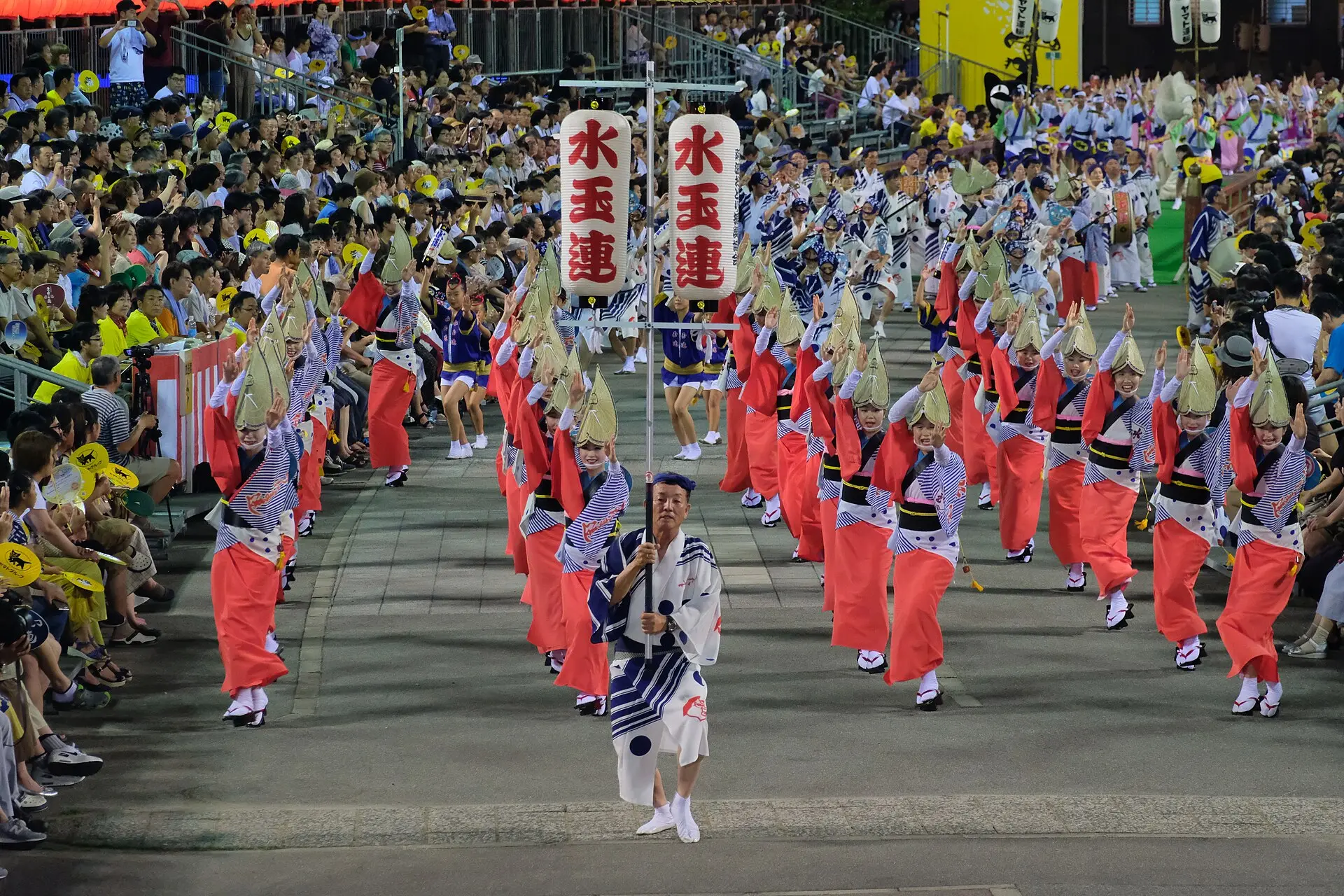
For four days at Obon, dance groups called ren move through the city. In Shikoku's summer, dance turns an entire city into a stage.
Tokushima Prefecture presents several theories for the origin of Awa Odori: that townspeople danced to celebrate the completion of Tokushima Castle; that it derives from a furyū dance at Shōzui Castle; and that it grew from the Bon dances of the seventh lunar month.
Dancers perform in groups called ren, formed by neighbourhood, workplace or school, each passing down its own dance with shamisen, drums, gongs and flutes.
In Kōchi, also on Shikoku, the Yosakoi festival began in 1954, led by the Kōchi Chamber of Commerce and Industry, to shake off a recession and pray for the health and prosperity of citizens. The naruko clappers dancers hold derive from bird scarers once shaken in the fields.
One descends from Bon dance, the other was born of post-war civic effort. Different in origin, both share those hours when groups of dancers advance through the city and the line between dancer and onlooker softens.
Related festivals
Sources & references
- 1.阿波おどり|ようこそ徳島県へ(external site, opens in a new tab)徳島県
- 2.阿波おどり:徳島市公式ウェブサイト(external site, opens in a new tab)徳島市
- 3.2026 開催スケジュール | The Awaodori(external site, opens in a new tab)阿波おどり未来へつなぐ実行委員会
- 4.徳島市阿波おどり THE AWAODORI | 徳島県観光情報サイト阿波ナビ(external site, opens in a new tab)徳島県観光協会
- 5.「風流踊」のユネスコ無形文化遺産登録(代表一覧表記載)(external site, opens in a new tab)文化庁
- 6.よさこい祭りとは < よさこい祭り 公式サイト(external site, opens in a new tab)よさこい祭振興会
- 7.2026年 第73回よさこい祭り開催スケジュール < よさこい祭り 公式サイト(external site, opens in a new tab)よさこい祭振興会
Read more